
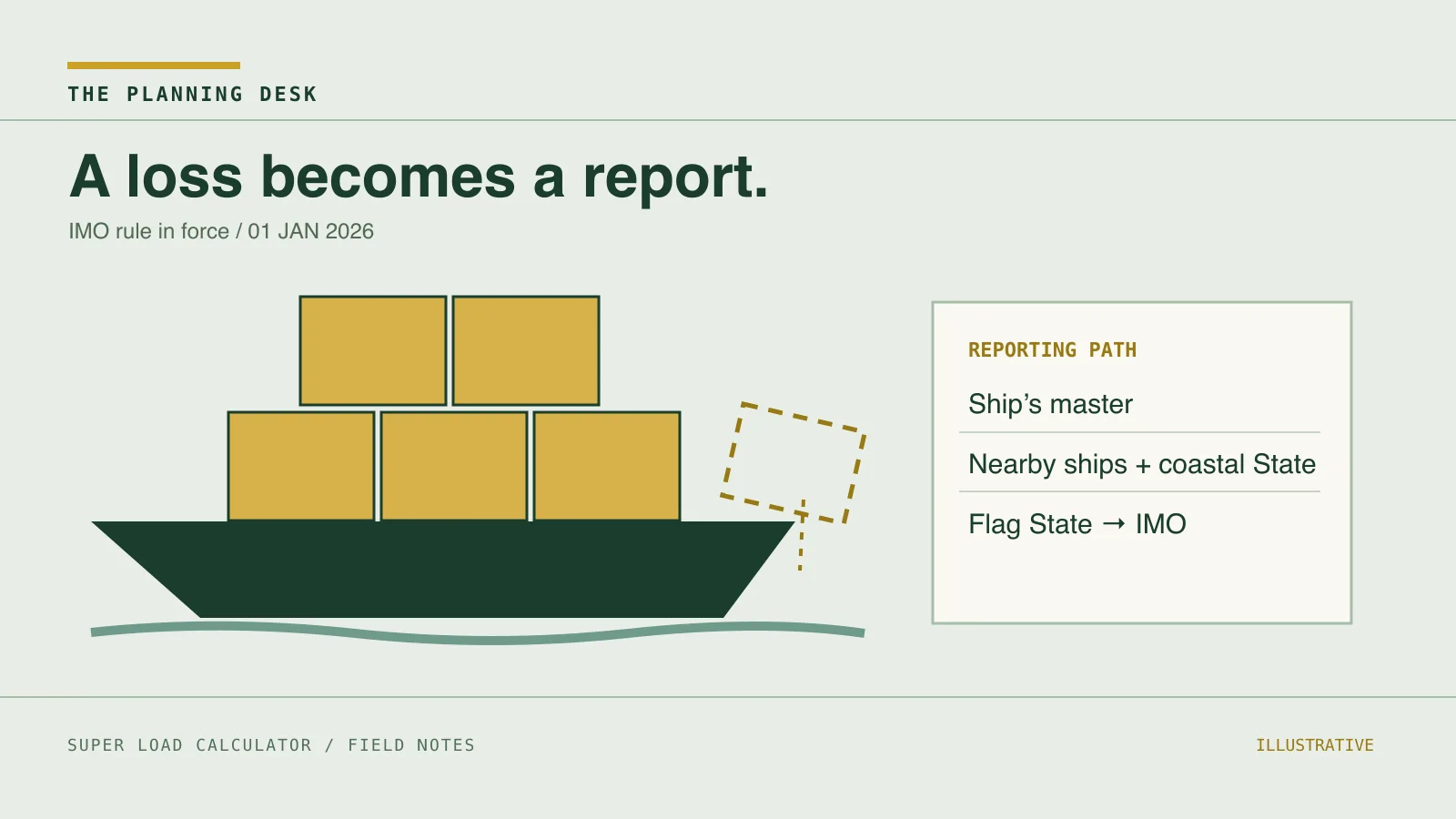
A rule on reporting freight containers lost at sea took effect on 1 January 2026. It concerns what happens after a loss: the ship’s master must communicate incident details so nearby ships and authorities can respond. It does not turn a container loading plan into a cargo-securing certificate.
What changed on 1 January 2026?
According to the International Maritime Organization, amendments to SOLAS and MARPOL introduced mandatory reporting of freight containers lost overboard. The master of a ship involved in a loss must communicate the particulars to ships nearby, the nearest coastal State and the flag State. The flag State then reports the incident to IMO. The information includes the position and number of containers lost where available.
The immediate purpose is to alert those who may encounter a navigation hazard and to improve reporting of losses. The rule is about incident communication, not a new requirement that a shipper use a particular planning application.
What should a cargo team take from it?
The reporting duty sits with the vessel after an incident, but the story begins earlier for everyone involved in packing. Good cargo information helps the handover: identify the pieces, their gross weights, handling limits and the actual unit. Keep the planning record distinct from the physical inspection and securing record.
Keep three checks separate
- Planning: do the packed pieces fit in the proposed equipment in a usable arrangement and sequence?
- Packing and securing: has the load been physically checked, distributed and secured for the intended journey under the responsible team’s procedures?
- Verified gross mass: has the packed container’s mass been verified and communicated under the applicable SOLAS process? The IMO explains the VGM requirement, which has applied since 2016.
These checks connect, but one does not prove the others. A 3D plan cannot verify the weight of the sealed container. A verified weight cannot show that every piece was placed and secured correctly. The IMO/ILO/UNECE CTU Code is the broader guidance source for packing and securing cargo transport units.
The useful habit: a traceable handover
Keep the final cargo list, equipment details, loading order and any changes made at the dock together. Share the version that reflects what was actually loaded. That record supports clear communication between shipper, packer, forwarder and carrier, while the responsible parties still perform the physical and regulatory checks.
Source note: This news explainer is based on IMO’s 9 January 2026 announcement. It describes the international rule at a general level; operators should check the requirements and procedures that apply to their voyage.
Put your cargo data into a plan.
Use your packed cargo details to inspect a proposed container or trailer arrangement.
Keep the cargo-record review practical
Use the Google blog cargo-record checklist, read our Medium explanation of the 2026 reporting rule, and prepare the Substack cargo-record briefing. The LinkedIn cargo-record checklist provides a short introduction to share.