
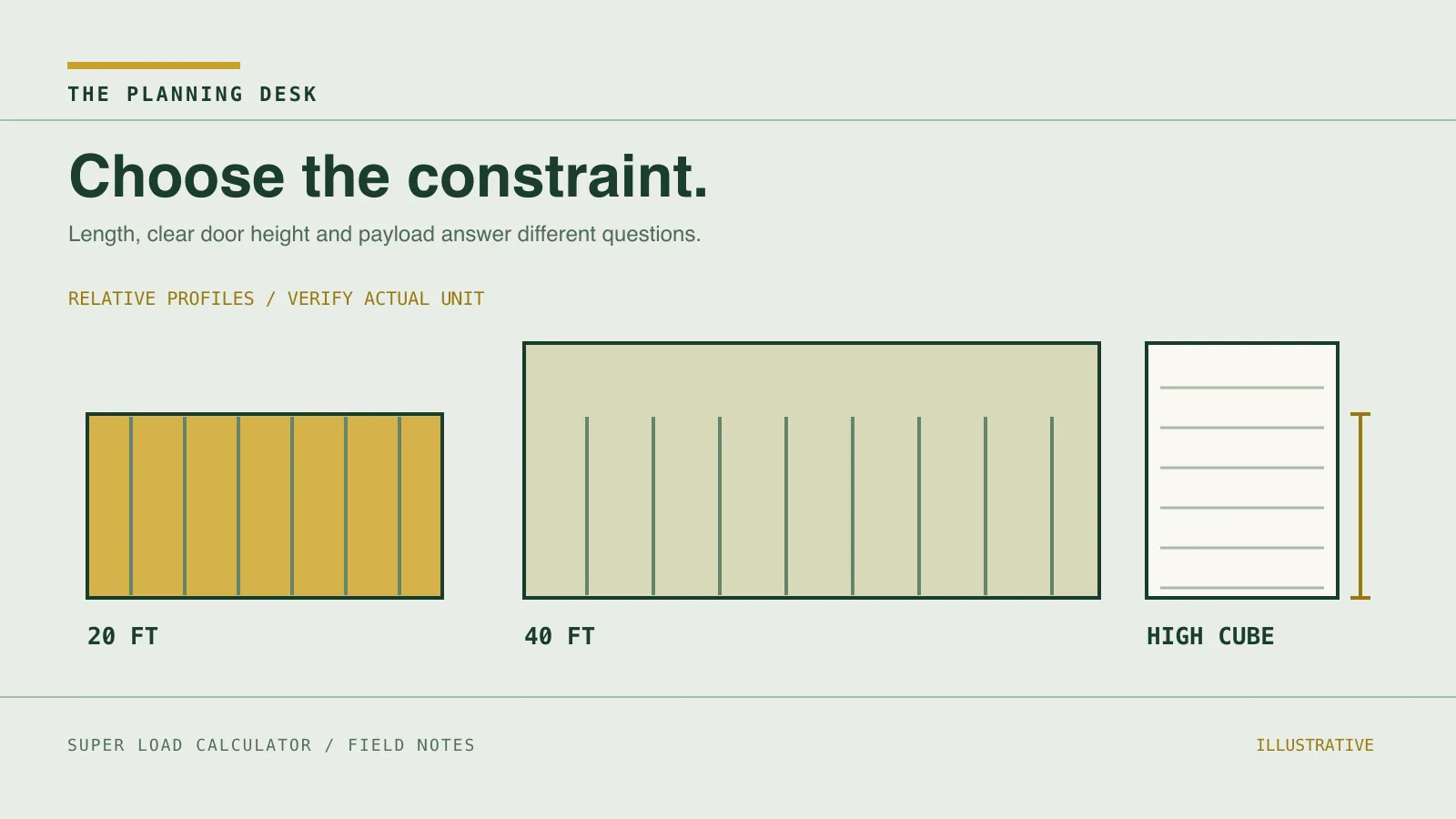
“How many cubic metres?” is a reasonable first question. It is a poor final answer to “Which container should we book?” A 20-foot dry, 40-foot dry and 40-foot high-cube container differ in length, height, door opening and usable payload. The cargo’s shape and weight decide which difference matters.
20ft, 40ft and high-cube container capacity
A 20ft standard container has 33.2 m³ of cubic capacity in Hapag-Lloyd’s published fleet example. Its listed maximum payload is 28,130 kg. Cubic capacity measures space; payload measures cargo weight. Neither figure alone establishes how much of your particular cargo will fit.
| Equipment example | Cubic capacity | Maximum payload |
|---|---|---|
| 20ft standard | 33.2 m³ | 28,130 kg |
| 40ft standard | 67.7 m³ | 28,750 kg |
| 40ft high cube | 76.3 m³ | 28,600 kg |
CBM means cubic metres, a volume measure. Read what CBM means and why it cannot confirm cargo fit. Packing gaps, door clearance, cargo rules and payload can limit the usable load before the stated cubic capacity is reached.
Compare the dimensions that can stop a load
A 40-foot dry unit is longer than a 20-foot dry unit. A 40-foot high cube adds height to the 40-foot format. But extra volume does not automatically solve a door-clearance or payload problem. In one Maersk equipment specification, the listed clear door height is 2,280 mm for its 20-foot and 40-foot standard dry units, and 2,585 mm for its 40-foot high cube. These are examples from one carrier’s equipment sheet, not guaranteed dimensions for the unit you will receive.
| Equipment | Question it helps answer | Check before booking |
|---|---|---|
| 20-foot dry | Can a shorter unit carry the cargo without exceeding weight limits? | Length, payload, door and loading access |
| 40-foot dry | Does more floor length let the pieces fit in a workable arrangement? | Payload, floor loading and sequence |
| 40-foot high cube | Will extra internal and door height solve a genuine height constraint? | Actual clear door height and handling rules |
Three loads that a CBM comparison can misread
Tall cargo
A crate that must stay upright has to clear the doorway as well as fit inside. A high cube may offer more height, but measure the packed crate and verify the available unit’s clear opening before committing to that equipment.
Heavy, compact cargo
A dense shipment may reach a weight limit while much of the container remains empty. Check the unit’s maximum payload, any route restrictions, the intended support on the floor and the required verified gross mass process. The IMO’s VGM guidance explains the separate requirement to verify the mass of a packed container before vessel loading.
Mixed pieces with access constraints
A long unit may have enough total space but still produce an awkward loading order. Check whether the intended placement is reachable with the available handling equipment and whether any delivery or unloading sequence limits where pieces can sit.
A useful booking decision
- List packed dimensions, gross weights and handling rules for every cargo type.
- Compare those pieces with each candidate unit’s actual interior, clear door opening and payload.
- Inspect a proposed placement, unplaced pieces and the loading sequence—not only the utilisation percentage.
- Confirm the equipment supplied, route limits and securing method with the responsible operators.
You can choose fixed equipment or compare allowed equipment combinations in the container planner, using your packed cargo and handling rules. That comparison makes the equipment choice explainable to a shipper, forwarder and warehouse team. A planning result helps narrow the options; it does not replace the carrier’s equipment specification or a securing calculation.
Test your candidate load.
Use your packed cargo list to compare a proposed arrangement with the equipment available to you.
Continue the equipment comparison
Use the Google blog container-booking checklist, read the Medium guide to the limiting constraint, and brief your team with the Substack pre-booking memo. The LinkedIn container-choice checklist gives a short version to share.